1990 Ford F350 Xlt Lariat Super Duty Reviews
| Eighth generation | |
|---|---|
 | |
| Overview | |
| Manufacturer | Ford |
| Product | 1986–1991 (USA, United mexican states, Canada and Venezuela)[one] 1987–1992 (Australia)[2] 1988–1992 (Argentina) 1993–1995 (Brazil) 1993–1995 (Argentina, Brazilian trim model) |
| Assembly | Cuautitlán, Mexico Kansas City, Missouri, Usa Norfolk, Virginia, The states St. Paul, Minnesota, The states Full general Pacheco, Argentine republic São Bernardo do Campo, Brazil Louisville, Kentucky, USA Wayne, Michigan, USA Oakville, Ontario, Canada Melbourne, Australia (Broadmeadows Assembly Plant, Ford Australia) [2] |
| Trunk and chassis | |
| Body style | two-door pickup 2-door extended cab chassis four-door chassis cab 2-door chassis cab |
| Powertrain | |
| Engine |
|
| Transmission |
|
| Chronology | |
| Predecessor | Ford F-Series seventh generation (1980–1986) |
| Successor | Ford F-Series 9th generation (1992–1996) |
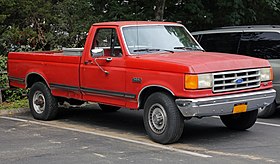
The eighth generation of the Ford F-Series is a line of pickup trucks and light- to medium-duty commercial trucks produced by Ford from 1986 to 1991. While the 1980 cab and chassis was carried over to the new model, the 1987 model was more streamlined, and maintenance items were made simpler. The outside was facelifted with new composite headlamps, a more aerodynamic forepart, and circular fenders. Within, the interior was given a consummate redesign. Rear antilock brakes were at present standard, the first pickup truck to boast this. For the outset fourth dimension, all models were produced with direct-sided Styleside beds; the Flareside bed was discontinued except for a small number of early 1987 models using leftover 1986 beds with new circular fenders. In 1991 Ford premiered the 9th gen tail lights (the white contrary light was decreased in size) on the last year of the eighth generation.
Trims [edit]

Ford F-250 Utility service truck
- Custom - Included: Vinyl upholstery, black steering wheel, chrome front bumper, blackness grille, hubcaps, foldaway mirrors, and an electronic AM radio with digital clock and two speakers.
- Forty - Added: Cloth and vinyl upholstery, swingaway mirrors, forepart bumper rub strip, colour-keyed floor mat, a door trim console with map pocket, and a color-keyed headliner.
- XLT Lariat - Added: Cloth upholstery, chrome grille, sport bicycle covers, tinted glass, carpeting, and leather wrapped steering cycle.
- Nite (1991)
For 1991, a "Nite" trim parcel was introduced. Information technology included all blacked-out exterior trim, either a pinkish or blueish/purple stripe, and a "Nite" decal on the sides of the cargo box.
Models [edit]

Eighth-generation Ford F-Series models are:
- F-150: 1/2 ton (six,250 lb GVWR max)
- F-250: light-duty 3/iv ton (seven,700 lb GVWR max)
- F-250HD: 3/iv ton (8,800 lb GVWR max)
- F-350: 1 ton Class two or Grade 3 truck (10,000 lb GVWR max)
- F-Super Duty: Grade 4 truck (xiv,500 lb GVWR max)[3]
The new-for-1987 F-Super Duty was essentially a Class four truck congenital as a chassis cab, with an aftermarket bed (specific to its future utilise) added after the truck was built. The F-Super Duty came with dual fuel tanks with a dash-mounted toggle switch to switch between each tank, while using only a single fuel estimate. It came with a PTO used to power attachments, such every bit winches or a dump bed, directly from the transmission. F-Super Duty models were rated at near 14,500 lb (vi,577 kg) GVWR and came with either the standard 7.five L (460 CID) gas V8 or the optional 7.three L (444 CID) diesel fuel V8. All wheels were ten-lug with dual wheels in the rear. The transmission was a 3-speed automatic, with the four-speed electronically controlled E4OD as an choice beginning in 1990.[iii] At that place was also a stripped chassis available, offering a sixteen,000 lb (7,257 kg) GVWR on two wheelbases of 158 or 178 in (4,013 or 4,521 mm) and the 7.three L diesel engine as the sole option.[3] This model should non be dislocated with the later Super Duty commercial line of trucks starting with the 1999 model year.
Powertrain and chassis [edit]
In a movement to further update the F-Series engine lineup, the iv.nine L inline-6 was converted to fuel injection for 1987. A year afterward, Ford became the get-go pickup truck manufacturer to sell a fully not-carbureted engine lineup as the 5.eight Fifty V8 and 7.v L V8 also gained fuel injection (the v.0 50 V8 had gained fuel injection as an option for 1985 and this was made standard in 1986). For 1988, the diesel V8 from International (Navistar) was enlarged to from 420 to 444 cubic inches (half dozen.9 to 7.3 L); this allowed for an increase to 180 hp (130 kW) and 365 ft⋅lbf (495 N⋅grand) of torque.
While the dated 3-speed column-mounted manual transmission was discontinued, much of the rest of the transmission lineup carried over from the 1980-1986 trucks. In 1988, the 5-speed ZF S5-42 replaced the Borg-Warner T19 in F-250 and F-350 models. For the F-150 and light-duty F-250, the heavier-duty Borg-Warner T18 4-speed manual remained bachelor, while the Mazda-congenital M5OD 5-speed manual was added to the model lineup for 4.nine L inline-half-dozen and v.0 L V8-equipped models.
Iv-wheel-drive improvements included the addition of automatic locking hubs for the F-150 in 1989. Models with the 5.0L V8 besides had an option of a "Touch Drive" electronic transfer case.[ citation needed ]
From 1980 through 1996, Ford offered a four-wheel-drive swing arm independent front interruption called Twin Traction Beam (TTB). Based on its two-wheel-drive twin I-beam suspension from 1965, Ford mounted a Dana 44 or Dana 50 differential in the driver-side front axle axle and transmitted torque to the passenger-side wheel with a U-jointed axleshaft. TTB ringlet springs were even so used on the F-150, while the four-bicycle-drive F-250 and F-350 got foliage springs. The F-250 received TTB Dana fifty axles, and the F-350 a solid Dana sixty axle.
Engines:
| Proper name | Production | Engine type/Displacement | Power | Torque | Fuel Commitment |
|---|---|---|---|---|---|
| 300 Six | 1987-1991 | 300 cu in (four,916 cc) I6 | 145 hp (108 kW) | 265 lb⋅ft (359 N⋅m) | EFI |
| five.0 Windsor | 1987-1991 | 302 cu in (4,949 cc) V8 | 185 hp (138 kW) | 270 lb⋅ft (366 N⋅one thousand) | EFI |
| v.8 Windsor | 1987 | 351 cu in (5,752 cc) V8 | 210 hp (157 kW) | 305 lb⋅ft (414 N⋅m) | 4-bbl carburetor |
| v.8 Windsor | 1988-1991 | 351 cu in (v,752 cc) V8 | 210 hp (157 kW) | 315 lb⋅ft (427 Due north⋅k) | EFI |
| 460 V8 | 1987 | 460 cu in (7,538 cc) V8 | 225 hp (168 kW) | 362 lb⋅ft (491 N⋅m) | 4-bbl carburetor |
| 460 V8 | 1988-1991 | 460 cu in (seven,538 cc) V8 | 225 hp (168 kW) | 390 lb⋅ft (529 N⋅thou) | EFI |
| International 6.9L IDI V8 | 1987 | 420 cu in (6,883 cc) Diesel fuel V8 | 170 hp (127 kW) | 315 lb⋅ft (427 N⋅thou) | Indirect fuel injection |
| International 7.3L IDI V8 | 1988-1991 | 444 cu in (7,276 cc) Diesel V8 | 180 hp (134 kW) | 345 lb⋅ft (468 N⋅thousand) | Indirect fuel injection |
References [edit]
- ^ Parker, Steve (August 1986). "Pickup Trucks Buyers' Guide". Pop Mechanics. Hearst Magazines. p. 97.
- ^ a b Kenwright, Joe (2006-09-29). "Used Automobile Advice: Ford F-series (1985-92)". Motoring. carsales.com Limited. Archived from the original on 2020-08-30.
- ^ a b c Mele, Jim (July 1990). "The New Models for 1991: Mid-Range Trucks". Armada Owner. Vol. 85, no. seven. FM Business Publications. p. 70.
Source: https://en.wikipedia.org/wiki/Ford_F-Series_%28eighth_generation%29

Post a Comment for "1990 Ford F350 Xlt Lariat Super Duty Reviews"